More 1D Acoustic Solver Examples
Overview
More 1D examples, following on from t01_AcousticSolverExamples1D, further capabilities of AcousticSolver in one-dimension.
- To open the file in the MATLAB Editor:
edit('kwave.tutorials.initialvalueproblems.t02_MoreAcousticSolverExamples1D.m') - To run the file in MATLAB:
run('kwave.tutorials.initialvalueproblems.t02_MoreAcousticSolverExamples1D.m')
See Also:
kwave.tutorials.initialvalueproblems.t01_AcousticSolverExamples1D.m
Preliminaries
This clears the workspace of any old variables
clearvars;
Import the k-Wave-II toolbox
import kwave.toolbox.*
Define a grid
Nx = 128;     % Number of grid points
dx = 1e-3;    % Grid spacing [m]
pmlSize = 20; % Thickness of the PML (Perfectly Matched Layer absorbing boundary)
kgrid = Grid(Nx, dx, pmlSize); % Create a Grid object
Define heterogeneous acoustic properties, and include acoustic absorption
Create an AcousticMedium object
medium = AcousticMedium(kgrid);
Define a spatially-varying sound speed (here a step change)
c0 = 1500*ones(medium.gridSize);
c0(1:end/2) = 1400;
medium.soundSpeed = c0; % [m/s]
Define a spatially-varying ambient density (also a step change)
rho0 = 1000*ones(medium.gridSize);
rho0(1:end/2)  = 940;
medium.density = rho0;  % [kg/m^3]
Define the acoustic absorption coefficient prefactor, the value for alpha0 in the expression for the absorption coefficient: alpha = alpha0 * f^y, where f is the frequency in MHz and y is the power law exponent (absorptionPower, which must be scalar).
medium.absorptionCoeff = 0.5;   % [dB/cm/MHz^y]
medium.absorptionPower = 1.9;
Note that when using absorption, the solver must be told:
solver = AcousticSolver(kgrid,medium,source,sensor);
solver.absorptionType='on';
Define an acoustic source
Create an AcousticSource object
source = AcousticSource(kgrid);
Define an initial acoustic pressure distribution
offset = floor(kgrid.Nx/4);
source.initialPressure = exp( -(kgrid.x - offset*kgrid.dx).^2 / (10*kgrid.dx^2) );
Define an acoustic sensor
Create an AcousticSensor object
sensor = AcousticSensor(kgrid);
Define a binary mask. The solver will return the field variables at the grid locations marked by 1 in the mask.
sensor.mask = zeros(kgrid.gridSize);
sensor.mask(end - floor(Nx/8)) = 1;
Record at every other timestep
sensor.timeStepSpacing = 2;
Run the simulation
Create an AcousticSolver object
solver = AcousticSolver(kgrid,medium,source,sensor);
Turn on the absorption
solver.absorptionType='on';
Define the CFL (Courant-Friedrichs-Lewy) number and endTime allow the timestep to be chosen automatically
cfl = 0.2;
endTime = 0.65 * kgrid.dx*kgrid.Nx / min(medium.soundSpeed(:));
Run the solver
solver.run(CFL=cfl, EndTime=endTime);
Calling kwave.toolbox.AcousticSolver.run...
  Input grid size: 128 grid points (128mm)
  Padded grid size: 168 grid points (168mm)
  dt: 133.2479ns, end time: 59.4286us, time steps: 446
run completed in 6.9449s
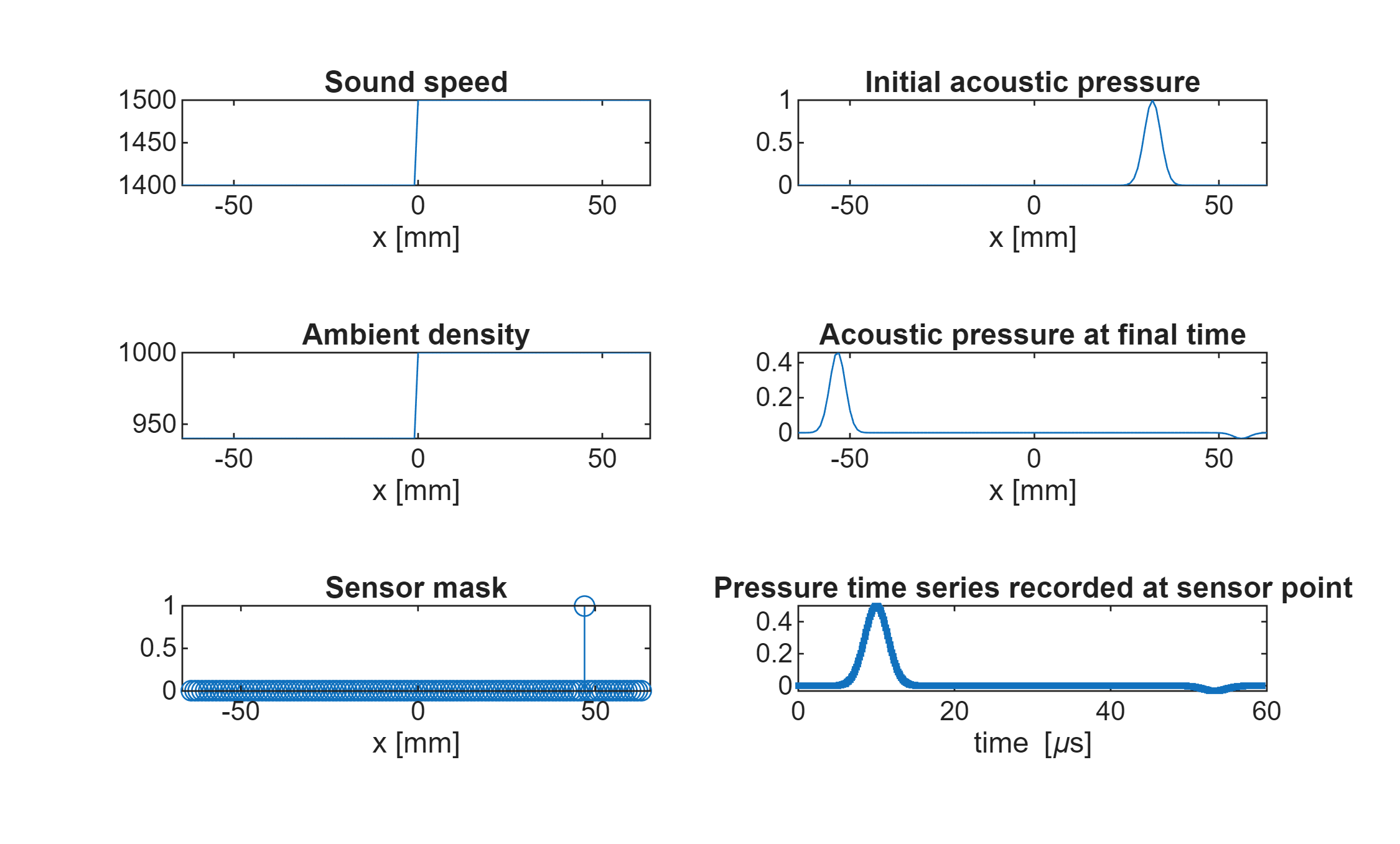
The simulation output
Plot the initial and final acoustic pressure fields
figure
subplot(3,2,1)
plot(kgrid.xVec*1e3,medium.soundSpeed)
xlabel('x [mm]')
title('Sound speed')
subplot(3,2,3)
plot(kgrid.xVec*1e3,medium.density)
xlabel('x [mm]')
title('Ambient density')
subplot(3,2,5)
stem(kgrid.xVec*1e3,sensor.mask)
xlabel('x [mm]')
title('Sensor mask')
subplot(3,2,2)
plot(kgrid.xVec*1e3,source.initialPressure)
xlabel('x [mm]')
title('Initial acoustic pressure')
subplot(3,2,4)
plot(kgrid.xVec*1e3,solver.pressure)
xlabel('x [mm]')
title('Acoustic pressure at final time')
subplot(3,2,6)
plot(sensor.times*1e6,sensor.pressure,'.-')
xlabel('time [\mus]')
title('Pressure time series recorded at sensor point')